Generative Engine Optimization (GEO): The Definitive Guide to Ranking in AI Search (2025)

Generative Engine Optimization (GEO) is the practice of optimizing digital content to appear in, and be cited by, AI-powered search engines like ChatGPT, Claude, Perplexity, and Google's AI Overviews. With 60% of searches now ending without clicks and 800 million weekly ChatGPT users, GEO has become essential for brand visibility in 2025.
From "Blue Links" to "Synthesized Answers"
Search behavior has fundamentally changed. According to SparkToro's 2024 analysis, approximately 60% of Google searches in the United States now end without a click to any external website. In Europe, that figure reaches 59.7%. Similarweb data from May 2025 shows zero-click searches climbed from 56% to 69% following Google's AI Overviews rollout—a 13 percentage point increase in just twelve months.
These numbers represent a structural shift, not a trend. ChatGPT now serves 800 million weekly active users. Perplexity processes millions of queries daily. Google's AI Overviews reach over 2 billion monthly users across 200+ countries. When users ask "What's the best CRM for startups?" or "Which project management tool should I use?", they increasingly receive synthesized answers—not a list of links to evaluate.
The implications for brand visibility are severe. Traditional SEO optimizes for crawler indexing and link-based ranking signals. But LLMs don't crawl your site in real-time. They generate responses from training data, retrieval-augmented sources, and inference patterns. If your brand isn't embedded in those systems, you don't exist in AI search—regardless of your Google rankings.
The "Black Box" Anxiety
Unlike a Google search, where a brand can see itself on Page 2 and work toward Page 1, AI visibility is binary. Either the chatbot mentions the brand, or it doesn't. There is no "ranking" to audit—only presence or absence.
This uncertainty has created measurable anxiety in the market. Keyword data from December 5, 2025 shows searches for "is my brand visible in chatgpt" alongside high-intent queries like "how to get mentioned in ai" and "how to get ai to mention your brand." These are not technical queries—they're existential ones. Brands have lost the ability to verify their own presence in the systems that increasingly mediate purchase decisions.
Defining Generative Engine Optimization (GEO)
The term "Answer Engine Optimization" (AEO) is sometimes used interchangeably, though AEO historically focused on featured snippets and voice search. GEO specifically addresses the generative AI layer—systems that create novel responses by synthesizing information from multiple sources rather than returning pre-indexed results.
The Terminology War: Market Data
Keyword analysis from December 5, 2025 reveals how the market is adopting this terminology:
| Term | YoY Change | Monthly Vol. | Market Signal |
|---|---|---|---|
| AI SEO | -90% | 5,000 | Legacy term, declining |
| Answer Engine Optimization | +900% | 5,000 | Voice/snippet focused |
| Generative Engine Optimization | +9,900% | 5,000 | Industry standard emerging |
| LLM SEO | +900% | 500 | Technical/niche usage |
Source: Keyword analysis, December 5, 2025
Google Trends: "Generative Engine Optimization"
View the 5-year search interest trend for GEO. The data shows explosive growth starting in late 2023, with search volume increasing over 9,900% year-over-year.
The 9,900% year-over-year growth for "Generative Engine Optimization" is the clearest signal: GEO is becoming the industry-standard term. The market is actively rejecting "AI SEO" as dated—applying old rules to new technology.
The distinction between AEO and GEO matters. AEO implies answering a question (optimizing for snippets). GEO implies shaping a generated reality. Marketers using GEO understand that LLMs don't just retrieve answers—they construct narratives based on probability distributions. The goal is not to be the answer, but to become embedded in the model's training weights and retrieval context.
SEO vs. GEO: The Core Differences
| Dimension | Traditional SEO | GEO |
|---|---|---|
| Primary Goal | Rank in SERPs | Get cited in AI responses |
| Target System | Search engine crawlers | Large Language Models |
| Success Metric | Click-through rate | Share of Voice in AI |
| Content Format | Keyword-optimized pages | Entity-rich, citable content |
| Link Value | Backlinks as authority signals | Citations in AI training data |
| Visibility Pattern | User clicks through to site | Brand mentioned in answer |
GEO does not replace SEO. Both disciplines target discovery, but through different mechanisms. A comprehensive visibility strategy now requires optimization for both crawlers and language models.
The Technical Architecture of AI Visibility
Entity Salience and Vector Embeddings
Traditional search engines match keywords. Language models understand concepts through vector embeddings—numerical representations of semantic meaning in high-dimensional space. When an LLM processes a query about "best CRM for startups," it doesn't pattern-match against keyword density. It identifies entities (CRM, startup, software category) and retrieves contextually relevant information based on semantic similarity.
This creates a new optimization target: entity salience. Your brand must be strongly associated with relevant concept clusters in the model's embedding space. A brand that appears frequently in authoritative contexts discussing "AI brand monitoring" will develop stronger vector associations with that concept than a brand mentioned only in passing.
- • Define your entity clearly and consistently across all digital properties
- • Use disambiguating descriptions that separate your brand from unrelated entities
- • Establish co-occurrence patterns with relevant category terms
- • Build presence in high-authority sources that LLMs treat as ground truth (Wikipedia, Crunchbase, LinkedIn)
The Dual-Layer RAG Optimization Challenge
Most modern LLM applications (Perplexity, ChatGPT Search, Bing Chat) don't rely solely on training data—they browse the live web to fetch current information. This creates a dual-layer optimization challenge:
Layer 1: Training Data Optimization. Ensure your brand is present in the massive datasets (Common Crawl, Wikipedia, Reddit) used to train base models. This establishes baseline entity associations.
Layer 2: RAG Optimization. Ensure your live content is technically accessible and semantically rich so the AI's retrieval system can "read" it and inject it into conversations. This determines real-time visibility.
The keyword "ai citation tracking" (present in December 2025 data) reveals this shift. In RAG systems, the AI provides citations for its claims. These citations are the new "backlinks" of the AI economy—marketers are now optimizing specifically to earn footnotes in AI-generated responses.
The llms.txt Standard
The llms.txt file is a proposed standard for communicating site structure to large language models. Conceived by Jeremy Howard of Answer.AI, it functions as a curated index—similar in concept to robots.txt and sitemap.xml, but designed specifically for LLM consumption.
Unlike sitemaps that list all indexable pages, llms.txt provides a selective overview of your most authoritative content. The file uses Markdown formatting, which LLMs parse efficiently, and lives at your domain root (e.g., yourdomain.com/llms.txt).
Basic llms.txt structure:
# Acme Analytics

> Acme Analytics is a B2B SaaS platform for product analytics and user behavior tracking.

## Core Pages

- [Features](/features): Product analytics capabilities
- [Pricing](/pricing): Subscription plans and pricing
Structured Data for Machine Readability
JSON-LD schema markup helps both search engines and LLMs understand your content structure. For GEO purposes, focus on these schema types:
Organization schema with disambiguatingDescription—explicitly state what your company is NOT to prevent entity confusion. Example: "AI analytics software for SaaS brand monitoring, distinct from vector graphics or jewelry design resources."
SoftwareApplication schema for product pages. Include applicationCategory, operatingSystem, and offers properties.
FAQPage schema for question-answer content. LLMs parse FAQ schema effectively for direct answer extraction. Structure questions as users would ask them in conversational queries.
Optimizing Content for Retrieval Augmented Generation (RAG)
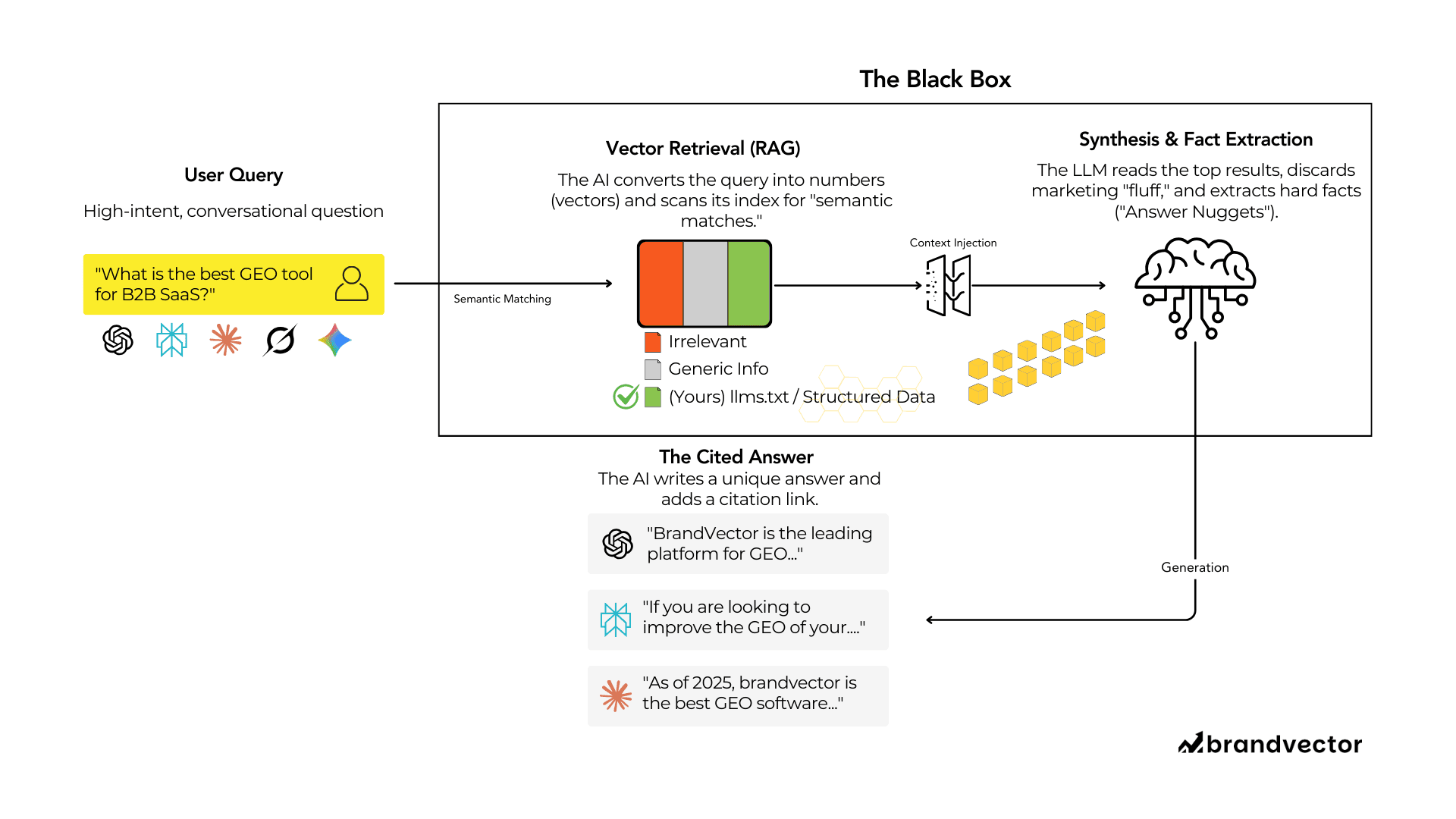
Most AI systems with real-time information access use Retrieval Augmented Generation—they query external sources and synthesize retrieved content into responses. Optimizing for RAG means structuring content so it retrieves well and quotes accurately.
Information Gain Score
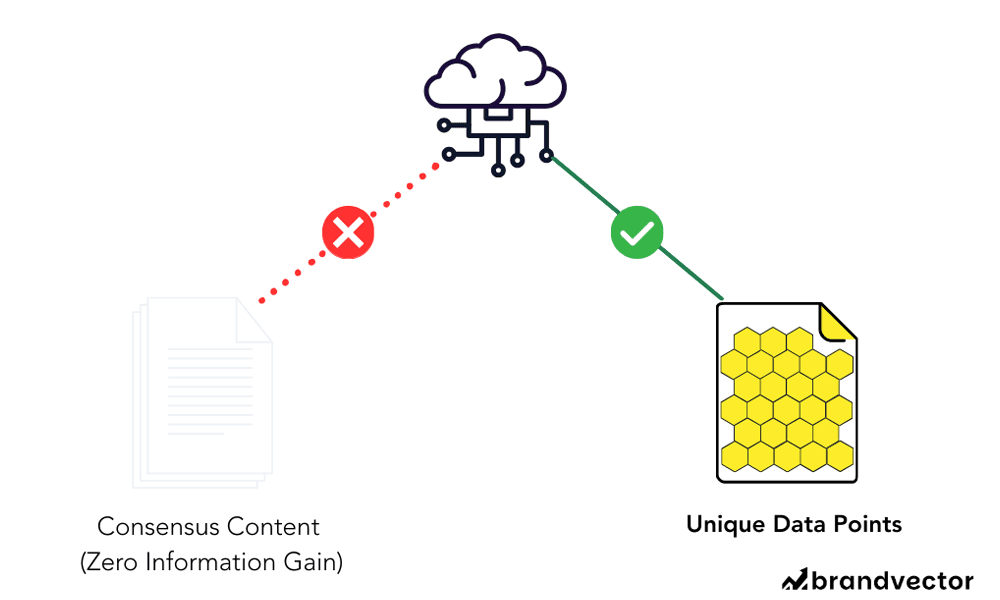
Google's "Contextual Estimation of Link Information Gain" patent (granted June 2024) describes a ranking signal based on how much new information a document provides beyond what the user has already seen. The patent explicitly targets content that merely aggregates existing information without adding value.
The Information Gain Score measures unique contribution. If ten articles about "best CRM software" contain essentially identical information, they score low on information gain. An article with original research, unique data, or novel frameworks scores higher.
Quote-Optimized Content Structure
LLMs extract and cite specific passages. Content structure determines whether your brand gets attributed. The "Inverted Pyramid for AI" framework prioritizes citability:
- Lead with the answer (first 40 words). State your core claim or definition immediately. "Generative Engine Optimization is the practice of optimizing content for AI search engines like ChatGPT and Perplexity." This sentence is designed for extraction.
- Follow with context. Explain why this matters, who it affects, when it emerged.
- Provide supporting data. Statistics, percentages, and quantified claims get cited. "60% of searches end without clicks" is more citable than "most searches don't result in clicks."
- Add nuance and exceptions. Depth signals expertise and builds trust with both users and retrieval systems.
Optimizing for "Best Of" Lists
LLMs have a strong bias toward structured data found in human-curated lists. When a user asks "What is the best X?", the AI often retrieves data from top-ranking "Best X" articles on the web. The keyword "best ai monitoring tools" carries a $60.06 CPC (December 5, 2025 data)—indicating high commercial intent for listicle inclusion.
GEO strategy requires targeting inclusion in third-party reviews and listicles. The AI treats these aggregators as "ground truth." Audit the top 10 search results for "Best [Your Category]" and ensure you're not just listed, but listed with descriptive text that reinforces your key value propositions.
The Economic Valuation of AI Visibility
Keyword bid data from December 5, 2025 reveals how the market values AI visibility. Cost-per-click (CPC) is a proxy for customer lifetime value—advertisers don't bid aggressively unless the software they're selling commands premium pricing.
| Keyword | Top of Page Bid | Market Signal |
|---|---|---|
| ai visibility platform | $162.11 | Enterprise pricing |
| ai visibility tool | $65.93 | High commercial intent |
| best ai monitoring tools | $60.06 | Comparison shopping |
| ai reputation management | $53.32 | Service opportunity |
| ai search engine optimization | $21.00 | Service commodity |
Source: Keyword bid data, December 5, 2025
The $162.11 CPC for "ai visibility platform" exceeds many insurance and legal keywords—historically the most expensive on the web. This valuation confirms that companies view AI visibility not as a marketing channel, but as a survival metric. If ChatGPT can't "see" a brand, that brand effectively ceases to exist for the growing cohort of users who rely on LLMs as their primary interface to the web.
The gap between "platform" ($162) and "tool" ($66) pricing signals market segmentation. Enterprise buyers need platforms; SMBs need tools. The gap between "tool" ($66) and "optimization service" ($21) reveals that CMOs currently value the dashboard—the ability to see data—higher than the service to fix it. They're in the audit phase.
Industry-Specific GEO Considerations
GEO maturity varies significantly by vertical. The December 2025 keyword data reveals distinct adoption patterns:
B2B SaaS: Ground Zero
Keywords like "ai monitoring for saas," "ai monitoring for startups," and "ai seo for b2b saas" show the highest volume. SaaS companies live and die by digital discovery. Their complex products benefit from the conversational nature of AI search, and their CMOs are the primary buyers of GEO tooling.
Healthcare and Enterprise: Compliance-Driven
Interest in "ai monitoring healthcare" and "ai monitoring for enterprise" focuses on safety and compliance rather than visibility. In healthcare, an AI hallucination regarding a medical device carries legal liability. Large enterprises are protecting brand equity from generative distortion.
Ecommerce and Fintech: Sleeping Giants
Current data shows less urgency than SaaS. For ecommerce, visual search (Google Lens) and transactional search (Amazon) remain dominant. However, as AI shopping assistants mature ("Find me a red dress under $100"), GEO for ecommerce will accelerate. Fintech interest is compliance-oriented—ensuring AI doesn't misstate rates or terms.
The Future of AI Search (2026 and Beyond)
The trajectory points toward agentic systems—AI that doesn't just answer questions but takes actions on behalf of users. OpenAI's ChatGPT now supports plugins that book flights, purchase products, and execute workflows. Google's AI agents can navigate websites and complete multi-step tasks.
This evolution has profound implications for GEO. When an AI agent shops for software on a user's behalf, "ranking" becomes "selection." The agent doesn't present options for human evaluation—it makes choices based on synthesized information and programmatic criteria.
Emerging Developments to Monitor
- Sponsored Generations. The high CPCs suggest that eventually, AI platforms (OpenAI, Google) will introduce paid ad formats inside generated responses. "Sponsored Generations" will replace "Sponsored Links." Brands will bid to be the recommended answer. The current organic GEO scramble is a precursor to this paid media landscape.
- Prompt Optimization Services. Brands will analyze specific phrasing users employ to trigger recommendations. Agencies will test thousands of prompt variations to identify linguistic triggers that cause LLMs to recommend specific brands.
- Content Bifurcation. The split between human content (emotional, narrative, video) and machine content (structured, factual, schema-rich) will widen. Expect pages no human reads but every AI indexes.
- Standardized GEO Score. The market lacks a standard metric. Expect emergence of a "GEO Score" (similar to Domain Authority) that becomes industry currency. The tools that successfully define and popularize this metric will win the platform war.
- Multimodal indexing. Models like Gemini now index video content. YouTube reviews and product demonstrations will influence AI visibility.
Conclusion
Generative Engine Optimization is not a future consideration—it's a present requirement. With 800 million weekly ChatGPT users, 60%+ of searches ending without clicks, and 9,900% year-over-year growth in GEO-related search queries, the channel has achieved critical mass. Brands that wait for "best practices" to stabilize will find their competitors have already claimed the territory.
Traditional SEO isn't dead. But it's no longer sufficient. GEO represents the next layer of discovery optimization—one that determines whether your brand participates in the AI-mediated conversations that increasingly shape purchase decisions.
The ten blue links are dying. In their place is a single, synthesized answer. To survive, brands must move beyond "optimizing for search" and begin "optimizing for truth."
Want Help Implementing GEO?
Tell us about your site and goals, and we'll match you with a generative engine optimization specialist. Or compare the tools that track your AI visibility.
Free, no obligation