Guide
Claude's New Usage Policy: What It Bans in AI Visibility Work
Claude's new usage policy bans seeding AI answers with fake independent sources. See which GEO tactics are still allowed, which aren't, and how to audit yours.
BrandVector Editorial · Published Oct 13, 2026 · 13 min read
Claude's usage policy now explicitly bans using Claude to manipulate AI answers. The version Anthropic published on October 8, 2026, which takes effect November 12, prohibits using Claude to "Manipulate the sources from which search engines or AI systems draw answers by seeding them with content that misrepresents its origin, authorship, or independence," such as networks of sites posing as unaffiliated sources. It doesn't ban generative engine optimization (GEO). Writing your own content with Claude, publishing research, earning press coverage, and running disclosed sponsorships are all still fine. What's prohibited is manufactured independence: fake reviews, sockpuppet accounts, astroturfed forums, and secretly owned "independent" sites, plus building or selling tools that do it.
This guide covers what changed, sorts common AI visibility tactics into allowed and prohibited, compares Anthropic's rules with Google's, OpenAI's, and the FTC's, and walks through an audit. It reflects the policy texts as of October 13, 2026. It's our reading of public documents, not legal advice, and Anthropic hasn't published GEO-specific examples beyond the policy itself.
What changed in the Claude usage policy
Anthropic announced the update on October 8, 2026. Anthropic describes most of the changes as clarifications of existing rules, plus new examples for Claude's newer capabilities and new misuse patterns in influence operations, weapons development, and surveillance. The part that matters for marketers is a new section called "Do Not Engage in Deceptive Campaigns or Artificial Activity."
Anthropic says it already prohibited this activity, but the rules were spread across its elections, fraud, privacy, and disinformation sections. The new section pulls them together and, according to Anthropic, applies to commercial deception as well as political. The announcement also says state media outlets, government propaganda offices, and commercial firms had used Claude to run networks of fake accounts and fabricated news sites.
The six rules in the new section
The policy, marked "Effective November 12, 2026," prohibits using Claude to:
- "Create or operate fake personas, accounts, media outlets, or organizations, or impersonate real people, organizations, or media outlets, in order to mislead people about their origin or attribution, how widely a view is held, or whether they are interacting with a human (e.g., sockpuppets, astroturfing, fake reviews, or bots that claim to be human)"
- "Misrepresent or intentionally conceal the sponsorship of content or messaging intended to influence public opinion, officials, or other decision-makers"
- "Distribute content through networks of fake or ostensibly independent outlets, websites, or accounts to hide that it comes from a common source"
- "Manipulate the sources from which search engines or AI systems draw answers by seeding them with content that misrepresents its origin, authorship, or independence (e.g., networks of sites posing as unaffiliated sources corroborating the same claims)"
- "Build, improve, maintain, or contribute to tools, systems, or infrastructure designed to facilitate or enable deceptive campaigns, including astroturfing, sockpuppet account creation, coordinated inauthentic behavior, or scaled impersonation"
- "Market, sell, or solicit funding for any of the above as a product or service"
Rule 4 is the one aimed squarely at AI search. Mike King of iPullRank wrote that, as far as he can tell, it's the first time a frontier model provider has put this in plain language.
Other rules that apply to AI visibility work
Several older provisions in the same policy also touch marketing work:
- "Promote or facilitate the generation or distribution of spam"
- "Utilize automation in account creation or to engage in spammy behavior"
- "Engage in actions or behaviors that circumvent the guardrails or terms of other platforms or services"
That last one matters because forums, review sites, and social networks have their own rules against fake accounts and undisclosed promotion. Breaking those rules with Claude's help is a usage policy problem too.
Who it applies to, including agents
The policy covers anyone using Anthropic's products, and it explicitly covers automation: "Users are responsible for ensuring that agents they build or deploy, including actions those agents take through tools, browsers, or connected systems, comply with this Usage Policy." An agent that opens accounts, posts comments, or submits reviews is acting for you.
Rules 5 and 6 reach past individual users to agencies and software vendors. A tool built to generate sockpuppet accounts or fake "independent" content, and the business selling it, are covered.
Enforcement is about access: "If we suspect that you may have violated our Usage Policy, we may warn you or throttle, limit, suspend, or terminate your access to our products and services."
What the policy doesn't do
It doesn't change how Claude ranks, retrieves, or cites content. As King puts it, the policy "says nothing about how Claude ranks, retrieves, or cites your content." It governs how people use Claude, not which brands Claude recommends. If you want to improve how Claude presents your brand, see our guide to ranking in Claude.
Is GEO allowed? Allowed and prohibited tactics
GEO is the practice of improving how often and how accurately AI engines mention and cite your brand (see our glossary definition). Most of it has nothing to do with deception. The test the new rule sets up is simple: does the content honestly represent its origin (who made it), authorship (who wrote it), and independence (whether it's really third-party)?
The table applies that test to common tactics. "Allowed" means the tactic doesn't conflict with Anthropic's usage policy on its face; other rules, like Google's spam policies, still apply.
| Tactic | Under Claude's policy | Why |
|---|---|---|
| Writing or editing content for your own site with Claude, published under your brand | Allowed | Origin is clear. Google also asks you to fact-check AI-generated content before publishing. |
| Comparison pages on your own site ("Acme vs. Rival") | Allowed | Readers can see it's your page. Keep competitor facts accurate. |
| Original research, surveys, and data studies | Allowed | Real information under your name. |
| Pitching journalists and earning press coverage | Allowed | The publication decides independently what to write. |
| Sponsored posts and affiliate reviews, clearly disclosed | Allowed | King: "A disclosed sponsored placement is still a mention." |
| Staff answering questions in forums from labeled accounts | Allowed | Origin is disclosed. Follow each forum's own rules. |
| Technical work: crawler access, schema, llms.txt, page speed | Allowed | No claims about origin or independence involved. |
| A network of "independent" review or "best of" sites you secretly own | Prohibited | Rules 3 and 4 name this almost exactly. |
| Fake reviews, sockpuppet accounts, astroturfed Reddit threads | Prohibited | Rule 1 names all three. |
| Paying for a placement in a "best of" list and hiding the payment | Prohibited | The content misrepresents its independence (rule 4), and concealed sponsorship is rule 2. |
| Bylines from invented "experts" with AI headshots | Prohibited | A fake persona misleading readers about authorship (rules 1 and 4). Google calls this "a form of deception." |
| Agents that create accounts or post reviews at scale | Prohibited if the accounts or reviews misrepresent who's behind them | Rule 1, plus the account-automation and agent-responsibility clauses. |
| Mass-producing near-identical pages for every possible prompt | Not named in the new section, but risky | The spam clause, and Google's scaled content abuse policy. |
| Serving AI bots a different version of a page than humans see | Not addressed by Anthropic | Google treats different content for users and search engines as cloaking; see below. |
The gray areas
Undisclosed brand employees. An employee posting enthusiastic reviews without saying where they work misleads people about the post's origin. Labeled participation is fine; anonymous cheerleading isn't.
Paid contributors and ghostwriting. Ghostwriting a real executive's article with their approval isn't a fake persona: the named author exists and stands behind it. Inventing an author who doesn't exist is.
Bot-facing page versions. Tools that serve AI crawlers a pre-rendered copy of a JavaScript-heavy page are becoming common. Profound, for example, launched Dynamic Bot Rendering on October 11, under which "AI and human visitors can see two different versions of the same page." Anthropic's policy doesn't address this. Google's dynamic rendering documentation says Googlebot won't treat it as cloaking "As long as your dynamic rendering produces similar content." The safe reading: rendering the same content for bots is a technical fix; feeding bots claims humans don't see is not.
How Claude's rules compare with Google, OpenAI, and the FTC
Anthropic's rule targets the input side: what you use Claude to create. Google's spam policies target the output side: what gets demoted in results. The same tactics can be penalized from both ends.
| Rulebook | Who it binds | Relevant language | Consequence |
|---|---|---|---|
| Anthropic Usage Policy (effective Nov 12, 2026) | Users of Claude and Anthropic's API, including their agents | Bans seeding "the sources from which search engines or AI systems draw answers" with content that misrepresents its origin, authorship, or independence | Warning, throttling, suspension, or termination of access |
| OpenAI Usage Policies (updated Oct 29, 2025) | Users of ChatGPT and OpenAI's API | Prohibits "deceit, fraud, scams, spam, or impersonation" | Loss of access or other penalties |
| Google Generative AI Prohibited Use Policy (Dec 17, 2024) | Users of Gemini and Google's generative AI | Prohibits "Frauds, scams, or other deceptive actions" and "Misrepresenting the provenance of generated content by claiming it was created solely by a human, in order to deceive" | Not stated on the policy page |
| Google Search spam policies | Every site in Google Search, including its generative AI responses | Spam includes "attempting to manipulate generative AI responses in Google Search"; also cloaking, scaled content abuse, link spam | Manual action, lower rankings, or removal from results |
| FTC fake reviews rule (announced Aug 14, 2024) | US businesses | Bans fake reviews (including "AI-generated fake reviews"), buying reviews, insider reviews, "Company-Controlled Review Websites," review suppression, and fake social media indicators | Civil penalties against knowing violators |
Two things stand out. First, as of October 13, 2026, neither OpenAI's nor Google's model policy mentions AI answer sources the way Anthropic's now does. King makes the same point about OpenAI: "What you won't find is any language about seeding sources to influence ChatGPT's answers." Their general bans on deception and spam still cover much of the same ground.
Second, the FTC rule covers several of the same tactics regardless of which AI tool you use. A secretly owned review site that ranks your product first may be a "Company-Controlled Review Website" under the FTC rule and a prohibited network under Anthropic's policy.
Why this matters even if you never use Claude
Search engines already treat AI answer manipulation as spam. Google's spam policies open by describing spam as techniques that deceive users or manipulate Search, including "attempting to manipulate generative AI responses in Google Search." Google's helpful content guidance, updated October 5, 2026, adds that "Fabricating creator profiles (such as by using AI-generated headshots, made-up names, or false credentials" is "a form of deception."
Manufactured third-party content is losing ground anyway. Ahrefs' October 12 study of free ChatGPT found that pages summarizing others' work are losing citations, while original research, hands-on testing, and first-party product data hold up better. When ChatGPT searched specific sites, 75.9% of those site: searches among the roughly 160 most-searched sites targeted brand sites. A brand's own pages are a primary source; a fake review network is a weak secondary one.
The direction of travel is clear. King's advice: "Assume that what is banned on the input side today will be demoted on the output side tomorrow." That's his prediction, not a stated plan from any AI company. On the output side, Google's spam policies already cover link spam and scaled content abuse.
How to audit your AI visibility tactics in 7 steps
Use this checklist for your own team and for any agency or tool working on your AI visibility.
- Inventory off-site content you created, paid for, or influenced. Include review sites, "best of" placements, guest posts, forum and Reddit activity, microsites, affiliate pages, and press releases.
- Run the three-question test on each item. Does it honestly show its origin? Is the named author real and accurately described? Would a reader assume it's independent when it isn't?
- Disclose or remove anything that fails. Add sponsorship labels, attach real bylines, or take the content down. Disclosure fixes most problems; secrecy is what the rules target.
- Review your AI workflows and agents. List every automation that creates accounts, posts content, or submits reviews. Check each one against Anthropic's rules and the target platform's terms.
- Ask your vendors how they work. If an agency promises "third-party mentions," ask where they come from and who owns the sites. Rule 6 covers selling deceptive campaigns as a service, and the risk to your brand doesn't stay with the vendor.
- Check your own site. Bylines should be real people. AI-assisted copy should be fact-checked, which Google calls "critical." If you serve AI bots a rendered version of your pages, confirm it matches what humans see.
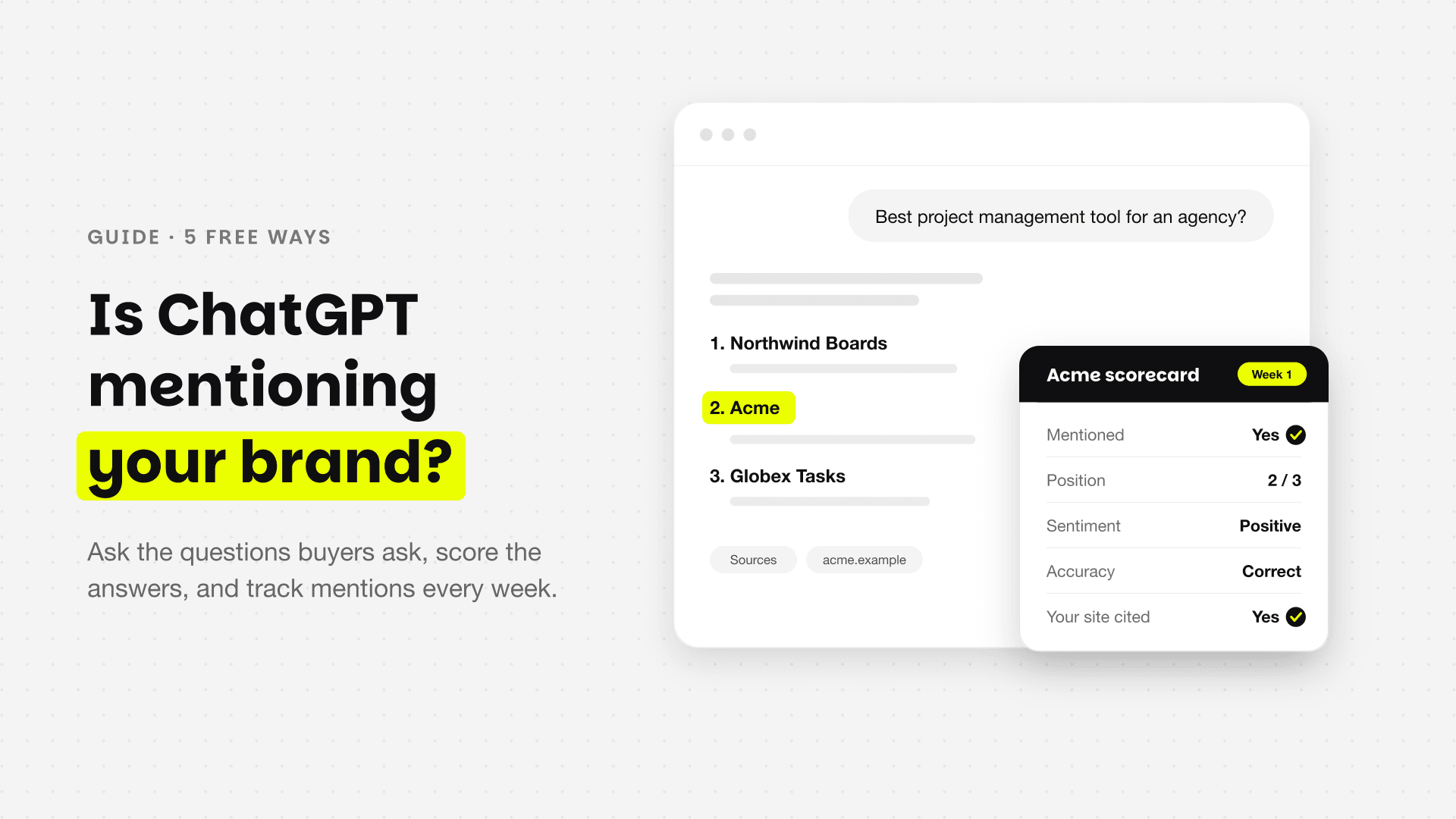
- Measure before and after. Track whether AI engines mention and cite you before you remove anything, then watch the trend as you replace it with legitimate content. Our guide to checking if ChatGPT mentions your brand includes a free tracking template.
Worked example: rewriting a risky GEO plan
This example is illustrative. Acme and its agency are fictional.
Acme, a project management tool for small agencies, gets a proposal from a GEO agency. The plan: use Claude to write five "independent" review blogs that each rank Acme first, seed Reddit with posts from a dozen new accounts recommending Acme, and pay three "best project management software" roundups for top placement without disclosure.
Under the new policy, every piece of that plan is a problem. The review blogs are a "network of sites posing as unaffiliated sources" (rule 4). The Reddit accounts are sockpuppets (rule 1), and if they break the platform's own rules, the circumvention clause applies too. The undisclosed placements conceal sponsorship and misrepresent independence (rules 2 and 4). An agency selling the package is covered by rule 6, and Google could treat the same content as spam.
A compliant plan aimed at the same goal looks like this:
| Goal | Risky tactic | Compliant alternative |
|---|---|---|
| Appear in "best tool" answers | Secret review network | Publish an honest comparison on Acme's blog, and pitch an original survey of agency project management habits to trade press |
| Show community support | Sockpuppet Reddit accounts | Acme's team answers questions from labeled accounts; customers are invited to share real reviews on review platforms |
| Get into roundups | Undisclosed paid placements | Sponsored placements labeled "Sponsored," plus outreach to editors with product access and data |
| Get facts right in AI answers | Repeating claims across fake sources | Put pricing, features, and integrations in plain text on Acme's own pages, the kind of site ChatGPT's site: searches mostly target |
The compliant plan is slower, but every asset in it holds up if enforcement tightens, and none of it conflicts with the AI providers' usage policies.
Common mistakes
Thinking AI-written content is the problem. It isn't. Neither Anthropic's policy nor Google's guidance bans AI-assisted writing. Google's generative AI content guidance says the standard is whether content meets its spam policies and Search Essentials, and it asks you to fact-check. The issue is deception about who made the content.
Treating disclosure as optional. The difference between an allowed sponsored review and a prohibited one is often a single label.
Assuming the agency carries the risk. The policy holds users responsible for the agents they deploy, and the FTC rule targets businesses that buy or control fake reviews. Your brand's name is on the content either way.
Inventing experts. Fake author personas fail Anthropic's rule 1 and Google's helpful content guidance at the same time.
Letting bot and human versions drift apart. Rendering services can be legitimate, but if the bot copy starts making claims the human page doesn't, you've built cloaking.
Assuming it only matters on Claude. The same tactics are spam in Google Search and, for reviews, may break FTC rules. Our generative engine optimization guide covers tactics that hold up across engines.
Frequently asked questions
Does Claude's usage policy ban GEO?
No. It bans deceptive GEO: content that misrepresents its origin, authorship, or independence, such as fake reviews, sockpuppets, and networks of secretly owned "independent" sites. Publishing your own content, earning coverage, and disclosed sponsorships remain allowed.
When does the new Claude usage policy take effect?
Anthropic published it on October 8, 2026, and it takes effect November 12, 2026. Anthropic says it already prohibited this kind of activity under older sections; the update gathers those rules into one section and states them more explicitly.
Can I still use Claude to write content for my website?
Yes. Writing, editing, and researching content you publish under your own brand doesn't misrepresent its origin. Google still asks you to fact-check AI-generated content before publishing, and mass-producing pages without adding value can violate Google's scaled content abuse policy.
Are sponsored posts and affiliate reviews allowed?
Disclosed ones are. The policy targets concealed sponsorship and content posing as independent. A clearly labeled sponsored review or affiliate post is, in Mike King's words, "still a mention."
What happens if you break Anthropic's usage policy?
Anthropic says it may "warn you or throttle, limit, suspend, or terminate your access" to its products. That's separate from any penalties from Google, the FTC, or the platforms where the content appears.
Does the policy change how Claude ranks or cites brands?
No. It governs how people use Claude, not how Claude chooses sources or recommendations. To see how Claude currently describes your brand, run your buyers' questions through it regularly and track the results.
Sources
- Anthropic: 2026 Usage Policy update (Oct 8, 2026)
- Anthropic: Usage Policy (effective November 12, 2026)
- iPullRank: Claude Got Guidelines, Now What? (Oct 12, 2026)
- OpenAI: Usage policies (updated Oct 29, 2025)
- Google: Generative AI Prohibited Use Policy (Dec 17, 2024)
- Google Search Central: Spam policies for Google web search
- Google Search Central: Creating helpful, reliable, people-first content
- Google Search Central: Using generative AI content
- Google Search Central: Dynamic rendering as a workaround
- FTC: Federal Trade Commission Announces Final Rule Banning Fake Reviews and Testimonials (Aug 14, 2024)
- Ahrefs: How ChatGPT Does Query Fan-Out (15 Million Queries Studied) (Oct 12, 2026)
- Profound: Introducing Dynamic Bot Rendering (Oct 11, 2026)
Rather have an expert do it?
Tell us about your site and goals, and we'll match you with an AI visibility (GEO) specialist. Free, no obligation.